
Tate County Court Records After Arrest
Tate County court records after a jail arrest are separate from the public jail roster. The roster is a custody tool maintained through the Tate County Sheriff's Office and OCV feed. It can show name, age, race, sex, booking date, charge descriptions, bond type, bond amount, and an image when one is available. The court record is different. It is the case file built by the clerk and court after a complaint, information, indictment, motion, order, or other filed paper reaches the court system.
The county courts page identifies Kenda Blount as Clerk of the County and Circuit Courts. The Circuit Clerk page says the office serves as clerk of circuit court and clerk of record for criminal and civil cases, receives and files indictments, motions, and other circuit court matters, issues summons and subpoenas, and provides record search. Felony criminal matters in Tate County also involve Mississippi's 17th Circuit Court District, where the district attorney prosecutes felony cases for the state.
Booking details and case details should be compared, not treated as the same record. For custody and intake fields, use the Tate County jail inmate records page. For booking photos tied to the roster, use the Tate County jail mugshots page. Court records after a jail arrest focus on filed charges, bond orders, indictments, warrants, motions, and final case action.
Find Tate County Court Records After Arrest
The researched court path for Tate County is the county clerk and Mississippi Electronic Courts. The Tate County courts page says Chancery Court records are maintained in MEC and can be viewed through free public terminals in the office or by registering for a user ID with the Supreme Court online registration page. It also says users must register through the MEC website to view the Circuit Clerk's civil court cases. The Mississippi Judiciary MEC page lists Circuit Court Tate County and Chancery Court Tate County for search and login access.
- Start with the sheriff roster and note the booking date, exact name format, charge wording, and bond type shown for the Tate County Jail entry.
- Decide whether the matter is likely in municipal, justice, county, circuit, or chancery records. Felony indictments and circuit criminal matters route through Circuit Clerk records.
- Use Mississippi Electronic Courts for available Tate County court records, or use a public terminal where the county says one is available.
- Search by party or defendant name when no case number is known, then compare the filed charges with the booking charges.
- Ask the clerk about older, sealed, lower-court, or non-electronic records if the case does not appear in MEC.
The Tate County courts page is the local starting point for court access, courthouse information, and MEC instructions. The Tate County Circuit Clerk page is the source for the clerk's criminal filing and record-search role. Those sources matter because a roster entry may be visible before the court case is complete, and lower-court records may not be reflected in the same way as circuit or chancery case records.
| Field Label | Type | Required | Notes |
|---|---|---|---|
| Court search/login | web portal | account required for remote access | MEC registration or login is required for online access. |
| Court | selection/search | required after login | MEC lists Tate County Chancery Court and Tate County Circuit Court. |
| Case number | text | optional or varies | Use when a case number is known from a clerk notice, docket, or filing. |
| Party or defendant name | text | optional or varies | Use to locate a case by person when no case number is available. |
| Public terminal | in-person access | no online login at terminal | Tate County says free public terminals are available for Chancery records. |
The Mississippi Judiciary MEC page shows the court search and login system used for electronic court access.
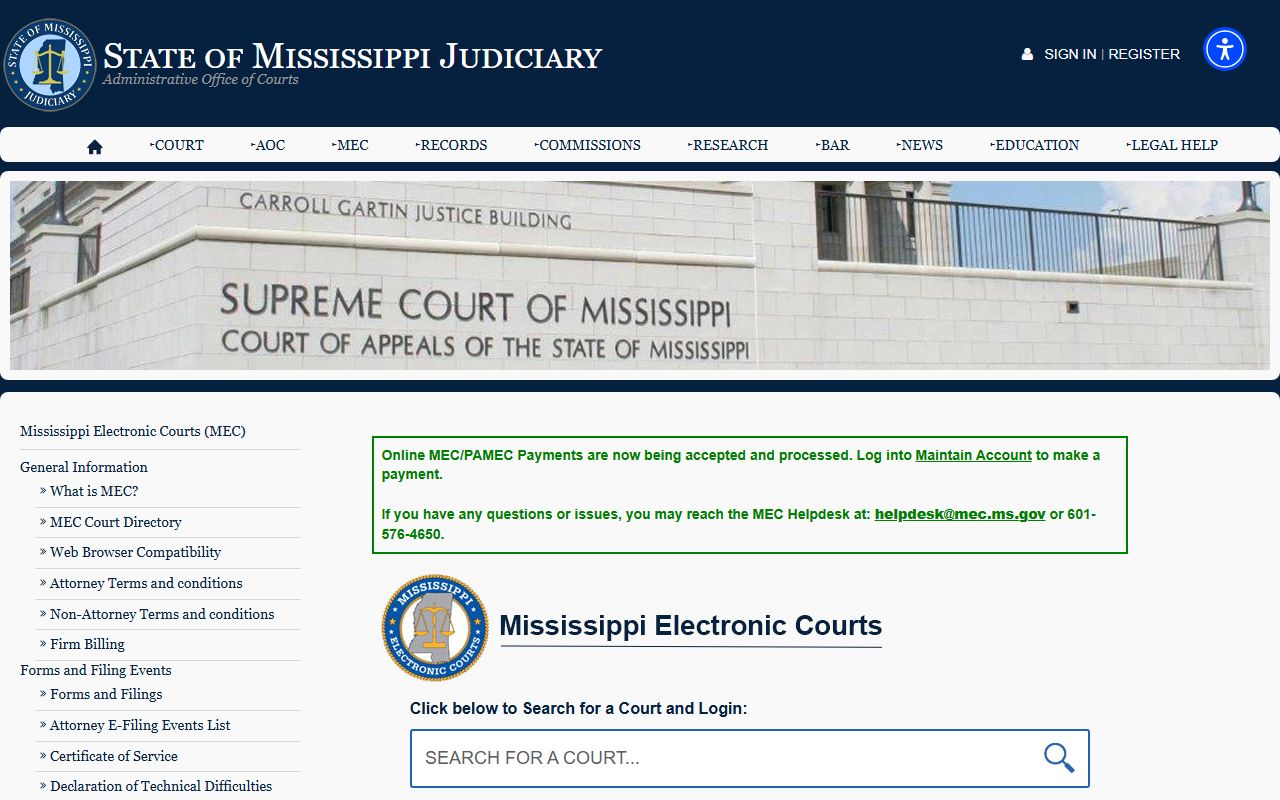
MEC is the statewide access point, while Tate County clerk records and public terminals remain important when a case is not easy to locate online.
Tate County Arrest Charges and Court Filings
A jail arrest can start with a charge label entered during booking. A court case begins when the right charging paper is filed or when the court receives the matter. In Tate County, the Circuit Clerk's duties specifically include receiving and filing indictments, motions, and other court-related matters in circuit court. That is why a roster charge such as warrant, writ, DUI, grand larceny, violation of probation, or drug court sanction should be checked against the later court record.
| Document | Who Uses It | What It Does | Tate County Record Point |
|---|---|---|---|
| Complaint | Law enforcement or prosecutor | States the initial accusation that starts or supports a criminal case. | May explain why an arrest moved into a lower-court or criminal case file. |
| Information | Prosecutor | Files a formal prosecutor charge in a criminal matter where allowed. | May use wording that differs from the jail roster charge. |
| Indictment | Grand jury | Charges a felony after grand-jury action. | The Circuit Clerk receives and files indictments for circuit court records. |
The Tate County Circuit Clerk duties page describes the clerk's role for criminal filings, civil filings, subpoenas, summonses, and record search.
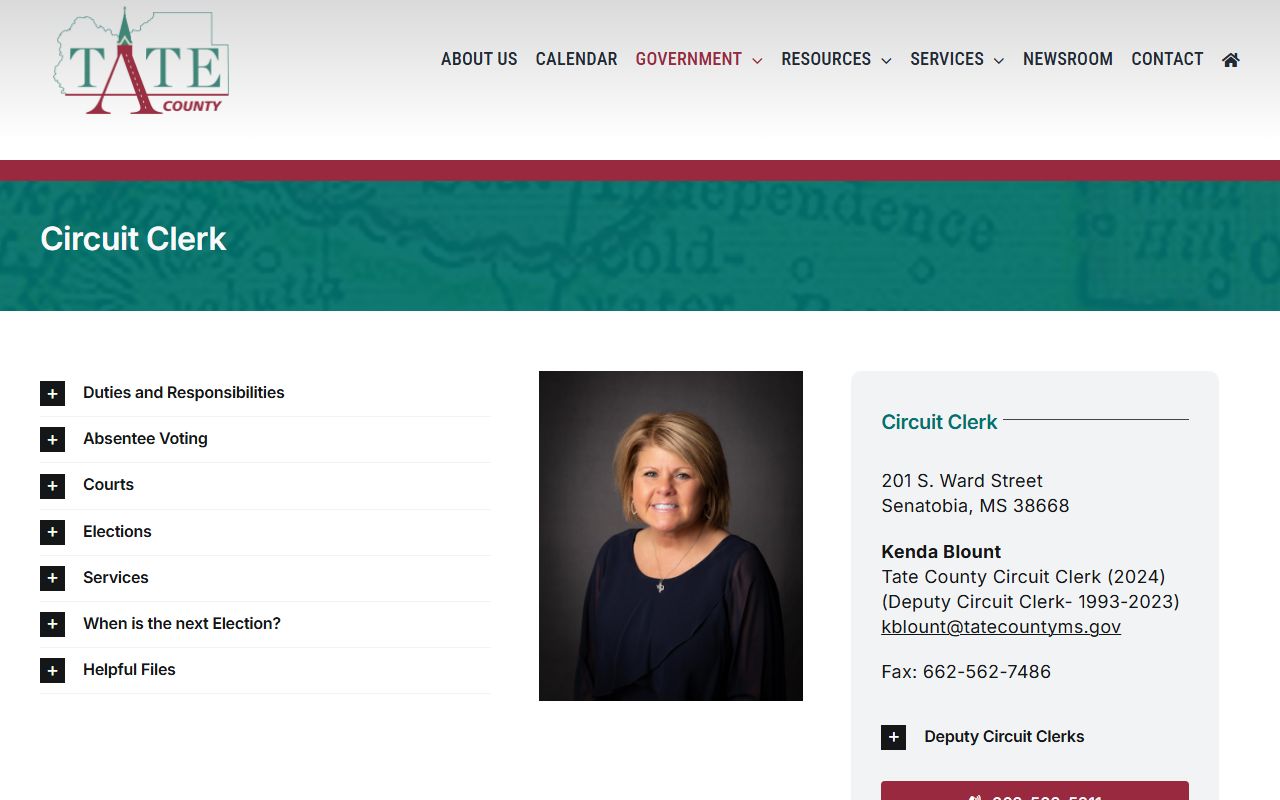
The clerk page is useful because court records after a jail arrest depend on filed case papers, not just the sheriff's booking feed.
Tate County Court Charge Status
Charge status can change after the booking date. The sheriff roster may show the charge entered at intake, but prosecutors and courts may add counts, reduce counts, amend wording, dismiss a count, or decline to proceed. The research identifies key terms used in criminal court records: pending, dismissed, reduced or amended, and nolle prosequi. Each term affects how a person should read court records after an arrest.
| Status | Meaning in a Court Record | Why It Can Differ From the Jail Roster |
|---|---|---|
| Pending | The charge or case has not reached final disposition. | The roster may still show the original booking charge and bond row. |
| Amended or Reduced | The filed charge changed after review, plea talks, or court action. | Booking language may use the arresting charge, not the final filed count. |
| Dismissed | The court ended the charge or case. | A past booking record can still show the arrest event unless restricted by law or order. |
| Nolle Prosequi | The prosecutor declined to proceed on the charge. | The arrest may remain visible in some record systems unless expunction applies. |
| Indicted | A grand jury returned a formal felony charging document. | The indictment may use different counts than the intake charge list. |
Note: A charge is an accusation or filed count, while a conviction requires a plea, verdict, or other final adjudication.
Bond Records After a Tate County Arrest
Bond is one of the clearest links between the jail roster and later court records. The Tate County roster shows bond data by charge, with observed bond types of Surety, Cash, ROR, No Bond, and N/A. Those labels are useful, but the research found no sheriff-posted local rule for payment methods, bond-posting hours, or counter procedures. The reliable path is to call Tate County Jail at 662-562-5466 before sending funds or hiring a bondsman.
| Bond Type | How It Works in Tate County Roster Use | What to Verify |
|---|---|---|
| Cash | Cash payment is required for the listed bond condition. | Confirm amount, payment method, and whether another hold blocks release. |
| Surety | A licensed bondsman or surety may post if the court allows it. | Confirm the bond is still current before paying a bondsman. |
| ROR | Release on recognizance, with no paid bond in the observed example. | Confirm any court date and all release conditions. |
| No Bond | Release is not available on payment alone for that charge or hold. | Ask whether a court order, writ, warrant, or probation matter controls release. |
| N/A | Bond data is not posted, not set, not applicable, or not populated. | Use the jail or court record to confirm status. |
Writs, warrants, foreign warrants, probation violations, contempt, drug-court sanctions, bond surrender, and protection-order type entries can all affect release. Court records may later show bond changes, arraignment settings, amended charges, or a new order that does not appear in the public roster right away.
Tate County Warrants and Arrest Records
No separate official Tate County active-warrant search page was located in the research. The sheriff site and app include a Most Wanted feature, but that is not a full warrant database. The inspected most-wanted feed had one entry and should be treated as an official wanted-person publication, not a complete list of all bench warrants, arrest warrants, writs, or failure-to-appear matters.
Roster examples show why warrant language matters. Public Tate County Jail entries included charge descriptions such as warrant, foreign warrant, writ to take custody, contempt, and failure to appear. Those labels can explain why a person was booked, but the public feed does not show the issuing court, warrant number, case number, or full warrant history. The next step is usually the issuing court, the clerk, or a written public-records request to the sheriff for releasable booking or warrant records.
Court Charges vs Convictions
Being arrested in Tate County is not the same as being convicted. A charge can appear at booking because an officer, warrant, court order, or hold brought the person into custody. A conviction means the court reached a final result through plea, verdict, or another adjudication. This distinction matters for employment, housing, licensing, personal safety decisions, and court follow-up, but the information is not a consumer report and should not be used for FCRA-covered screening.
| Point of Comparison | Charge | Conviction |
|---|---|---|
| Stage | Accusation, booking entry, complaint, information, or indictment. | Final court result after plea, verdict, or judgment. |
| Record Source | Jail roster, warrant, prosecutor filing, or court docket. | Court judgment, disposition, or sentencing record. |
| Meaning | The case is alleged or pending unless resolved. | The court has imposed or accepted a legal finding. |
| Can Change | Yes. Counts may be amended, reduced, dismissed, or indicted differently. | Usually changes only through appeal, post-conviction relief, expunction, or later court order. |
Sealed and Expunged Court Arrest Records
Mississippi public-records law starts from a rule of access. Mississippi's Public Records Act says public records are available for inspection unless another law provides otherwise. That does not mean every arrest, court record, juvenile matter, sealed file, investigative record, or expunged record stays public. Tate County offices may deny, redact, withhold, or delay access when an exemption, court order, juvenile restriction, investigative limit, or expunction applies.
| Point of Comparison | Sealed | Expunged |
|---|---|---|
| Public Visibility | Hidden from ordinary public access by court rule or order. | Removed or legally cleared for eligible records under an expunction order. |
| Record Holder | The court or agency may keep a restricted version. | The person should use the court order with record-holding agencies. |
| Mississippi Source | Depends on the case type, court order, and applicable confidentiality law. | Miss. Code § 99-19-71 covers eligible Mississippi misdemeanor, felony, and nonconviction expunction records. |
| Practical Step | Ask the clerk whether the file is restricted and what proof is required. | Follow the court expunction process, then contact each record holder with the signed order. |
The county may charge fees for searching, reviewing, redacting, copying, and delivering records under Miss. Code § 25-61-7. Public-records disputes can involve the Mississippi Ethics Commission under Miss. Code § 25-61-13.
Tate County Prosecutor and Court Path
Tate County is in Mississippi's 17th Circuit Court District for district-attorney purposes. The Mississippi Attorney General circuit court district map lists District 17 as Panola, Tallahatchie, Tate, and Yalobusha, with District Attorney Jay Hale and phone 662-563-6636. The Mississippi Bar prosecutors section also identifies James "Jay" Hale in Senatobia for the District Attorney's Office, 17th District. No dedicated official district-attorney website with a Tate County office page was located in the research.
For a felony arrest, the district attorney's role is different from the sheriff's role. The sheriff runs the jail and booking record. The prosecutor decides how felony charges proceed in circuit court. The clerk files the court papers and maintains the court record. Victim or custody notifications can also route through Mississippi SAVIN or VINELink, where Tate County data is included.
Restricted Tate County Court Records After Arrest
Some court records after an arrest may be missing from a simple online search for a lawful reason. Juvenile records, sealed cases, expunged matters, active-investigation records, and restricted filings may not appear through ordinary public access. Older cases or lower-court matters may also require direct clerk contact because the research did not locate a single Tate County lower-court search portal that covers every warrant, complaint, municipal case, and justice court case.
Important: Tate County Inmate Population is not a consumer reporting agency, and court or jail data may not be used for FCRA-covered screening.
For official confirmation, verify with the record-holding office. Jail custody and booking questions go to Tate County Jail. Filed case and court record questions go to the clerk or court that holds the file. Sentenced state-prison custody belongs in the MDOC inmate search, while federal custody uses the BOP locator and immigration custody uses the ICE locator.
The Tate County courts page also shows the local courthouse access point for court information.
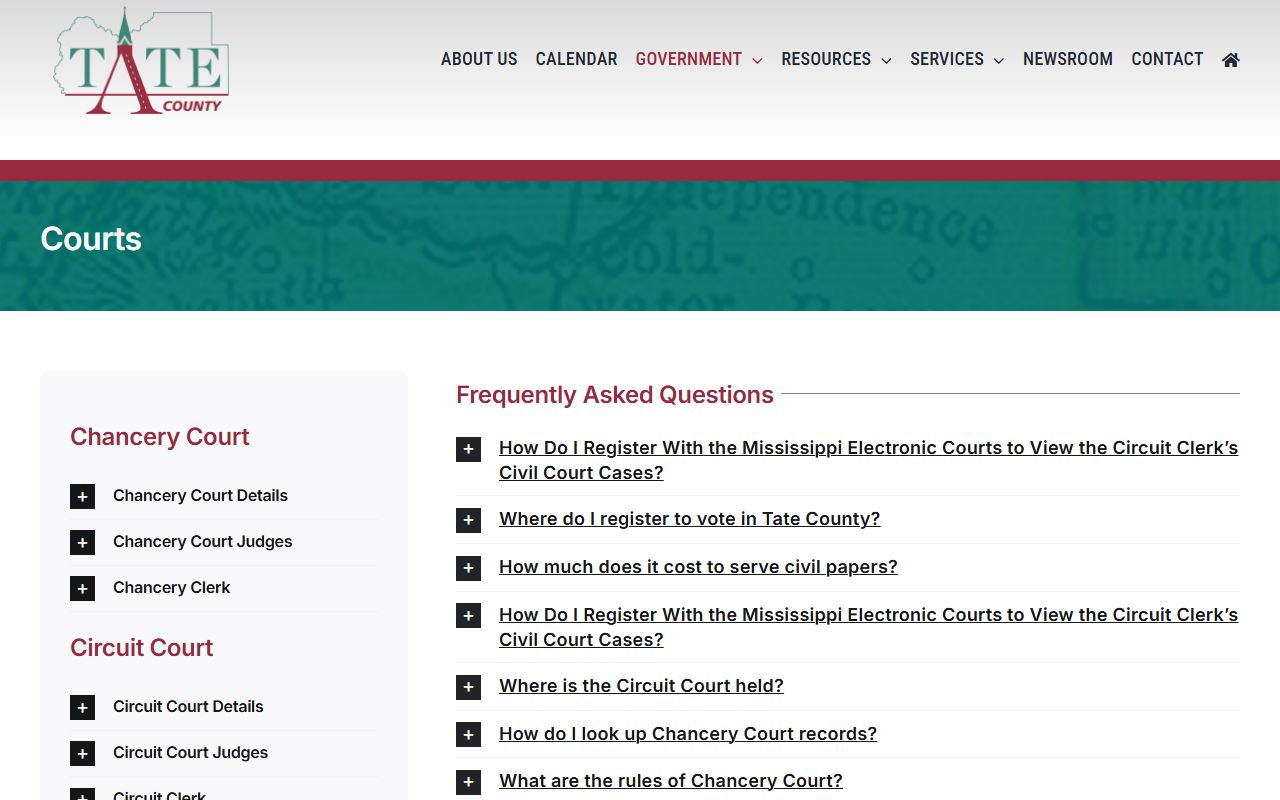
That county page is the local bridge between a jail arrest record and the court offices that maintain filed case records.